
Today, 11 November, is Remembrance Day – Armistice Day – which commemorates the official end of World War I with the signing of a Peace Treaty between Germany and the Allied Powers. Yet, it is well understood that the effects of war linger long after the cessation of armed combat. In the many years since the end of each of the World Wars, rich testimony of those who lived through them, both on battlefields and the homefront, has come to light. Even so, my recent work on War, Gender and Reflective Australia: Capturing the Shape and Form of War Experience, which I co-edited with Christine Jennett, suggests that there is much still hidden from view.
While I am sure most editors hope that a call for papers for a volume will strike a chord, in this case, we were touched to receive unexpected treasures of remembrance, reflection and scholarly study of the experience of war. We heard from people who had lived through World War II in Australia and Europe, and from those who had studied prominent women active in Australia in the war years and their aftermath. We were reminded that the art of a country also bears witness to lived experience. We feel privileged to have been allowed to work on all this meticulously documented material, with each piece revealing authentic and moving attempts to capture the shape and form of wartime experience: mainly in words, but also in paint, in stained glass, and in committed activism.
The volume focuses on the homefronts rather than the battlefields of war and uncovers fascinating material on the experience of women during war. We build on the Australian-focused studies of gender and war, begun systematically in 1995 with the publication of Gender and War: Australians at War in the Twentieth Century, edited by Joy Damousi and Marilyn Lake (Cambridge University Press). Like this volume, ours explores ‘the relationship between gender and war in Australia, the way in which . . . . engagement in war has profoundly shaped the politics of gender and . . . . gender relations gave shape and meaning to the prosecution of wars’ (p.1). The topic of gender and war has continued to be of interest since Damousi’s and Lake’s volume was published, though most of the more general studies have examined British, American or European contexts. The Australian record is still being compiled.
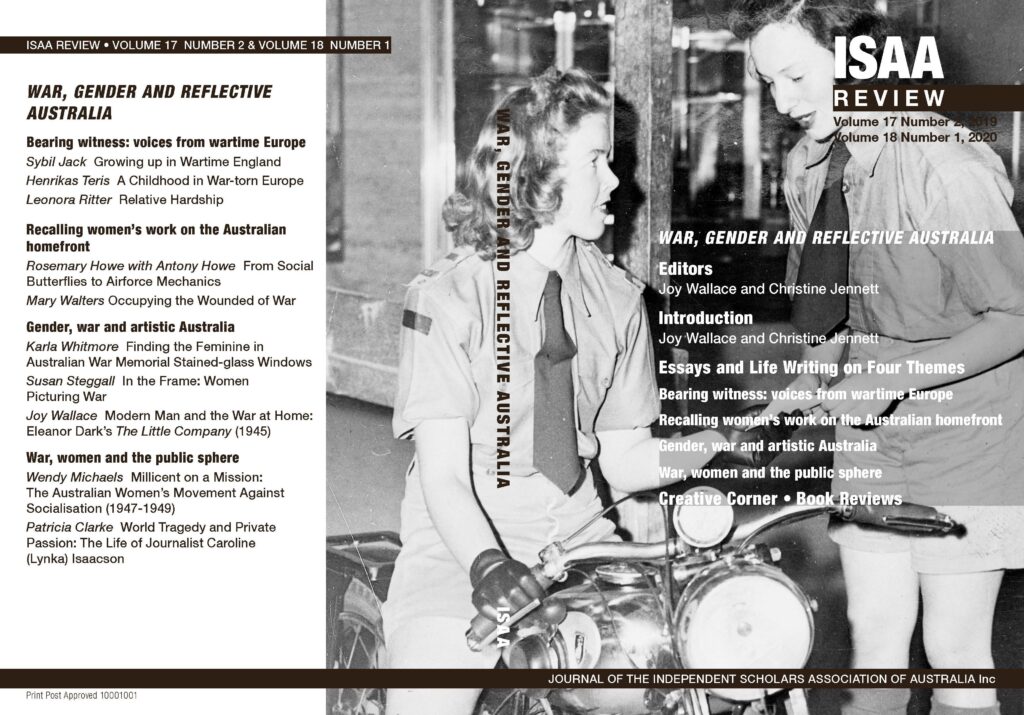
The Libraries Research Group at Charles Sturt University is committed to uncovering existing collections and archives and making them visible. We are also alert to the possibility of archives in the making. Together with the Independent Scholars Association of Australia, we plan to consolidate in book form the hidden archives of wartime experience in Australia captured in War, Gender and Reflective Australia. We are interested to hear about more unpublished material, particularly autobiographical pieces – and they might come from unexpected places! For our volume, we received some material from people who had lived through the war and written of their experiences, but other contributions came from their relatives and friends. Material came out of boxes in backyard sheds: Rosemary Howe’s autobiographical novel fragments were discovered by her son, Antony Howe, who edited and annotated them for our volume. We have here a vivid account of a young woman’s experiences as an airforce mechanic in Rose Bay, Sydney, and the joint opportunities and dangers for women on the Australian Homefront in the 1940s. Leonora Ritter turns her historian’s eye upon the collection of papers amassed by her father, Paul Ritter, who fled as a refugee from Europe to England and thence Australia. Ritter focuses on the female relatives who feature in her family papers and constructs a poignant account of their fortunes of war.
If you have access to any material of this kind, I would be very interested to hear from you. Please email me, Dr Joy Wallace, at jwallace@csu.edu.au
War, Gender and Reflective Australia: Capturing the Shape and Form of War Experience. Edited by Joy Wallace and Christine Jennett. ISAA Review: The Journal of the Independent Scholars Association of Australia Inc. Volume 17 Number 2 and Volume 18 Number 1, 2021.

Thank you for sharing this beautiful work with us all.
Thanks very much for your interest and support, Monica.
Best wishes
Joy