

Hamid JAMali & Philip Hider
Public libraries in many countries were quick to expand and promote access to their digital collections during the COVID pandemic, particularly during periods of lockdown. We analysed the usage data of two library networks in Greater Sydney and, as one might expect, the use of digital collections peaked during the New South Wales lockdowns. The graph below shows the normalised use of digital and physical collections from 2019 to 2021, with the two lockdown periods shaded. Zero indicates minimum use during the whole period under study and 1 represents the maximum use during this time.
Of course, libraries were also quick in finding ways to continue to provide access to their physical collection through services such as Click & Collect and Home Delivery, and we can see in the graph that while the use of physical collections dipped to the minimum at the start of each lockdown, it rapidly recovered.
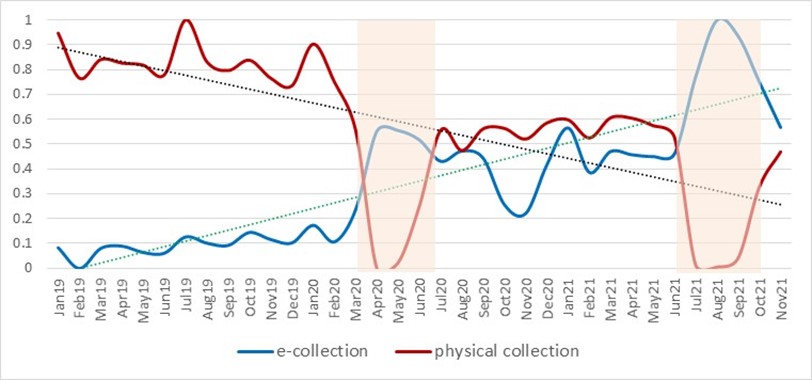
However, it was not clear by the end of the period of study whether the use of physical collections would reach its pre-pandemic levels, or whether the increased use of digital collections would stay relatively high. These trends might still be playing out, in fact. While nowadays we hear a lot about the end of the pandemic, many people still have health concerns and may remain conservative about visiting public places. Moreover, the pandemic might have caused behavioural changes that we are yet to fully identify.
The other critical point for librarians is that the increase in the use of digital resources by no means replaced or made up for the decrease in the use of physical collections. Besides the fact the users of physical and digital resources might be different groups, the difference between the volume of use is massive. In our study, while the use of digital resources increased by about 44,000 loans, the use of physical resources decreased by about half a million loans. A study of public libraries in the UK had similar findings and showed that the volume of loans for physical collection in most libraries went down by 70 to 90 per cent while e-loans went up between 100 and 200 per cent. However, this increase in e-loans was comparatively small compared to the losses in physical loans.
Libraries need to continue to carefully monitor the usage of their physical and digital collections post-pandemic. As well as continuing to promote, improve, and expand their online collections, libraries may need to explore ways to help reconnect users to the physical collections, especially where the library does not offer an online equivalent for the physical item, which is often still the case.

The paper is now available here: Jamali, H.R., & Hider, P. (2023). Changes in the Usage Pattern of Public Library Collections during the COVID Pandemic. Collection Management, https://doi.org/10.1080/01462679.2023.2210070